Ophthalmic B-Scan Ultrasound Machines in Nepal: A Buyer’s Guide for Hospitals and Equipment Distributors
The eye care delivery landscape in Nepal is expanding at an unprecedented rate. Driven by major healthcare investments across private eye centers, community vision hospitals, and university teaching institutions—from the Kathmandu Valley (Lalitpur, Bhaktapur) to major regional healthcare hubs like Pokhara, Biratnagar, Bharatpur, Birgunj, Butwal, Janakpur, Dharan, and Nepalgunj—the demand for high-precision diagnostic tools has never been greater.
When a patient presents with dense mature cataracts, severe corneal opacities, or acute ocular trauma, optical diagnostics like Optical Coherence Tomography (OCT) or digital fundus photography are rendered ineffective due to light attenuation. In these critical clinical scenarios, a high-resolution eye ultrasound machine is the definitive non-invasive diagnostic tool required to evaluate the posterior segment.
For hospital directors, clinical entrepreneurs, and medical equipment distributors evaluating an ophthalmic B-scan ultrasound machine in Nepal, selecting the right device requires a careful balance of acoustic physics, transducer frequencies, signal processing software, and seamless localized supply.
With our official regional presence in Nepal registered under Aadarsha Medical System, Mediscience Devices now offers direct, localized distribution, local billing, and doorstep technical support across the country.
This comprehensive B2B buyer’s guide explores the clinical mechanics of ocular ultrasonography, compares portable vs. console architectures, evaluates commercial investment factors, and demonstrates why sourcing through Mediscience Devices and Aadarsha Medical System is the most efficient choice for Nepali healthcare providers.
Clinical Imperative: The Role of B-Scan Ultrasound in Ophthalmic OPDs
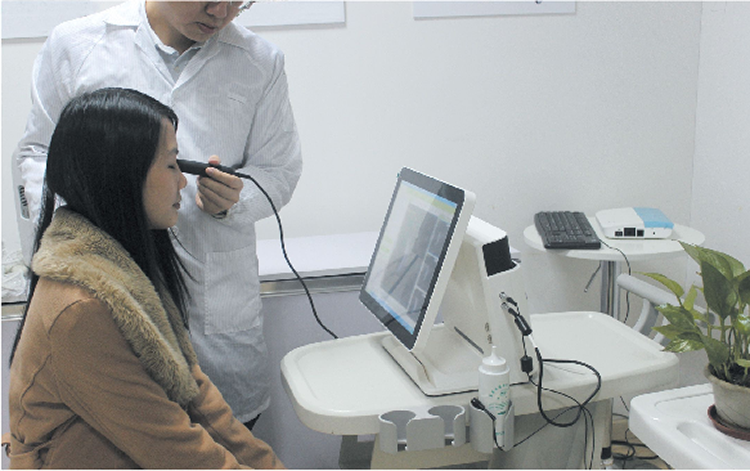
A two-dimensional brightness-mode (b scan) ultrasound scanner is an indispensable diagnostic instrument in modern ophthalmology. Operating at high acoustic frequencies (typically 10 MHz to 20 MHz), a b ultrasound scanner transmits acoustic pulses into the globe and processes the returning echoes to create a real-time, cross-sectional acoustic map of the vitreous cavity, retina, choroid, sclera, and retrobulbar space.
When evaluating options from ophthalmic equipment suppliers, hospital heads must recognize that a quality b scan eye machine bridges critical diagnostic gaps. In high-volume cataract OPDs across Nepal, performing a routine B-scan prior to cataract surgery on eyes with dense opacities prevents surgical surprises—such as an unsuspected pre-existing retinal detachment or posterior staphyloma.
Technical Physics: Transducer Frequency, Resolution, and Dynamic Gain
Understanding the acoustic physics inside a b scan machine helps procurement committees evaluate hardware performance beyond surface-level marketing claims.
1. Acoustic Transducer Frequency (10 MHz vs. 20 MHz vs. UBM)
10 MHz Standard Probes: The foundational workhorse for posterior segment evaluation. Provides optimal acoustic penetration ($> 50\text{ mm}$ depth) through dense vitreous hemorrhage and ocular tissue, delivering a wide sector view ($50^\circ$ to $60^\circ$) of the posterior pole and periphery.
20 MHz High-Resolution Probes: Delivers higher axial resolution ($\le 0.1\text{ mm}$) with reduced depth penetration ($\sim 20-30\text{ mm}$). Ideal for detailed examination of macular membranes, subtle vitreoretinal interface traction, and optic nerve head cupping.
50 MHz Ultrasound Biomicroscopy (UBM): Specialized high-frequency probe engineered exclusively for high-magnification cross-sectional imaging of the anterior segment (cornea, anterior chamber angle, iris, and ciliary body).
2. Dynamic Signal Gain & Gray-Scale Processing
Gain Control (dB Range): Advanced B-scan systems offer dynamic gain adjustment ranges from 1 to 105 dB. High gain settings amplify faint, low-echo signals (such as early vitreous floaters or subtle hyaloid membranes), while lower gain settings compress high-echo structures (such as calcified sclera or metallic IOFBs) to eliminate acoustic blooming.
256 Gray-Scale Levels: High-density digital signal processing renders subtle differences in tissue reflectivity, allowing clinicians to distinguish between smooth retinal detachments and diffuse vitreous haze.
Cine Loop Capture: Real-time dynamic imaging automatically buffers up to 56 consecutive frames. Clinicians can step through frame-by-frame during dynamic eye movement (kinetic scanning) to observe membrane mobility.
Structural Configurations: Laptop-Integrated vs. Standalone Consoles
When evaluating a b scan machine price proposal, buyers will encounter two distinct structural architectures. Comparing these forms helps determine the ideal fit for your hospital’s spatial footprint and mobility requirements:
A. Modular Laptop-Integrated Systems (High Mobility)
Systems such as the Suoer AB-Scan SW-2000 utilize a high-performance b scan probe connected via high-speed USB interface to a medical-grade or commercial laptop.
Key Advantages: Highly portable for multi-room OPDs, mobile screening camps, and Operation Theatre (OT) call-outs. Leverages high-definition laptop screens for crisp image rendering, and exports PDF/DICOM reports directly to hospital management systems.
Target Audience: Ideal for growing private clinics, multi-specialty regional centers, and mobile eye teams operating across Pokhara, Biratnagar, Janakpur, and Bharatpur requiring a portable B-scan machine for ophthalmology.
B. Dedicated Standalone Desktop Consoles (Stationary Lanes)
Standalone desktop units integrate the processing hardware, touch-screen display, and probe sockets into a single heavy-duty housing.
Key Advantages: Robust, all-in-one footprint designed for permanent installation on diagnostic tables. Features instant power-up and physical control knobs preferred by some senior clinicians.
Target Audience: Best suited for high-volume tertiary eye hospitals and academic teaching institutes in Kathmandu with dedicated ultrasound diagnostic suites.
Total Cost of Ownership (TCO) & Commercial Investment Tiers
Evaluating the overall ophthalmic ultrasound machine price Nepal dynamic requires looking beyond the initial invoice figure to evaluate Total Cost of Ownership (TCO) and long-term diagnostic yield.
Commercial Equipment Tiers
Standalone B-Scan Modular Units: Offers an economical entry point for regional eye centers focused primarily on posterior segment structural imaging prior to cataract surgery.
Integrated Dual-Mode AB-Scan Systems: Combines a 10 MHz B-scan sector probe with a 10 MHz A-scan biometry probe (equipped with IOL calculation formulas like SRK-T, Holladay, and Hoffer-Q) on a single software platform. Represents the standard investment tier for established eye hospitals, providing both axial length biometry and structural B-scan imaging from one compact workstation.
Multi-Probe Flagship Suites (B-Scan + A-Scan + UBM): Top-tier capital investment designed for university teaching hospitals and specialized vitreoretinal institutes requiring anterior segment UBM along with 10/20 MHz posterior imaging.
Value Drivers Impacting Investment Return:
Probe Build Quality & Shielding: High-grade piezo-ceramic crystals and durable acoustic cables prevent signal degradation and electrical noise over years of continuous clinical use.
A-Scan Biometry Integration: Selecting a dual AB-scan workstation optimizes capital expenditure by eliminating the need to purchase a separate standalone biometer.
After-Sales Support & Local Probe Replacement SLAs: Securing local spare parts through a registered in-country distributor protects daily clinic revenue and eliminates import downtime.
Master Product Comparison Matrix for Buyers in Nepal
To assist procurement committees, hospital boards, and clinical directors in evaluating diagnostic ultrasound technology, the table below compares key operational, technical, and commercial parameters:
| Diagnostic Modality | Primary Probe Frequency | Spatial Resolution Depth | Primary Clinical Target | Key Feature Advantage | Relative CapEx Profile |
| Standard B-Scan Workstation | 10 MHz Sector Probe | Axial $\le 0.2\text{ mm}$ (Depth $> 50\text{ mm}$) | Posterior segment mapping, Dense VH, RD, IOFB | Deep acoustic penetration through opaque media | Economical Entry-Tier |
| Integrated Dual AB-Scan Suite | 10 MHz B-Scan + 10 MHz A-Scan | Axial $\le 0.05\text{ mm}$ (A-Scan Biometry) | Complete Pre-Op Cataract Triage & Biometry | Combined A-scan IOL calculation + B-scan imaging | Balanced Professional Value |
| High-Res B-Scan / UBM Suite | 20 MHz B-Scan / 50 MHz UBM | Axial $\le 0.1\text{ mm}$ (High Magnification) | Vitreoretinal interface, Macular holes, Anterior angle | High-resolution microscopic acoustic visualization | Premium Institutional CapEx |
Explore Mediscience Devices’ complete portfolio on our Ultrasound A-Scan, AB-Scan, and Keratometer Category Page or review our complete product range on the Ophthalmic Equipment List Page.
Sourcing Strategy: Direct Local Supply in Nepal via Aadarsha Medical System
Navigating international supply chains to source high-precision medical technology can present challenges if an institution has to manage import logistics independently. Mediscience Devices resolves these friction points by offering a direct, registered local distribution model in Nepal.
Why Nepali Hospitals & Distributors Partner with Us:
Direct In-Country Supply & Local Billing: Hospitals and clinics can procure equipment with local VAT/PAN invoices directly through Aadarsha Medical System, simplifying internal accounting, local currency payments, and institutional auditing.
Elimination of Customs & Import Friction: We manage all cross-border clearance, freight logistics, and customs compliance from Kolkata into Nepal, delivering fully cleared equipment directly to your hospital doors.
Rapid Regional Dispatch: Operating from our local branches in Nepal, as well as maintaining direct supply links to Kathmandu and Pokhara, we ensure prompt equipment delivery and fast response times for service calls.
On-Site Installation & Training: Factory-trained biomedical engineers provide complete physical installation, software integration, acoustic probe calibration, and operational training for your clinical staff.
Turnkey Ophthalmic Setup: In addition to B-scan ultrasound machines, Aadarsha Medical System supplies the complete Mediscience product range—including autorefractors, tonometers, fundus cameras, slit lamps, and surgical microscope ophthalmology suites—allowing Nepali healthcare providers to outfit full diagnostic lanes from a single trusted partner.
Conclusion: Partner with Mediscience & Aadarsha Medical System
Equipping your hospital or diagnostic clinic with a high-precision B-scan ultrasound machine is an investment in diagnostic accuracy, patient safety, and clinical excellence. With our official local presence in Nepal registered under AADARSHA MEDICAL SYSTEM (Mirchaiya-10, Siraha / Janakpur-8, Dhanusha Branch), Mediscience Devices brings authentic global medical technology, direct local billing, and dependable engineering support directly to your practice.
If you are searching for trusted eye ultrasound machine suppliers Nepal or looking to buy B-scan machine from India with seamless local supply, partner with us today.
Contact the Sales Division at Mediscience Devices & Aadarsha Medical System today to request an official quotation, explore localized pricing for Nepal, and schedule a demonstration for your clinic.
People Also Ask
An A-scan (Amplitude scan) is a one-dimensional acoustic scan used primarily to measure axial length (cornea to retina) for IOL power calculation in cataract surgery. A B-scan (Brightness scan) is a two-dimensional cross-sectional scan used to visualize the structural architecture of the vitreous cavity, retina, choroid, and optic nerve head when opaque media blocks direct light examination.
Yes. Ultrasonic sound waves pass through dense media opacities (such as hyper-mature white cataracts, corneal leucomas, or vitreous hemorrhages) with minimal acoustic attenuation, providing clear structural images of the underlying retina and sclera.
Warranty support, preventive maintenance, and probe replacements are managed directly through Aadarsha Medical System alongside Mediscience Devices' factory-trained biomedical engineering team, ensuring fast technical response without overseas repair delays.
Yes. We specialize in turnkey clinic setups. Importers, hospitals, and private practices can bundle B-scan ultrasound machines alongside autorefractors, non-contact tonometers, fundus cameras, slit lamps, and operating room equipment into a single integrated procurement package.