

Description
Rexam AR, Kerato & Topographer, REF TOPO RET-700 for Ophthalmology Clinics & Eye Care Centres
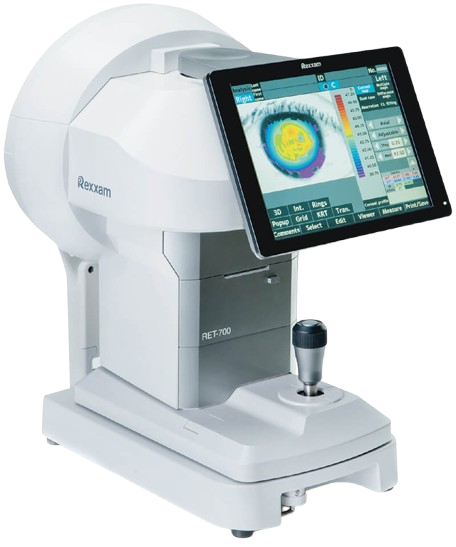
The Rexam AR, Kerato & Topographer, REF TOPO RET-700 is an advanced auto refractometer keratometer and corneal topographer designed for ophthalmology clinics, eye hospitals, optometry practices and professional eye-care facilities by Mediscience. By combining objective refraction, keratometry and corneal topography in a single platform, the RET-700 provides a comprehensive solution for anterior-eye examination and corneal assessment.
The Rexam RET-700 is designed as an all-in-one ophthalmic diagnostic system, integrating the functions of an autorefractometer, keratometer and corneal topographer, together with a built-in PC and database. This integrated configuration can help B2B eye-care facilities consolidate multiple diagnostic functions into a single examination unit.
As a professional corneal topographer, the RET-700 provides a measurement range of approximately 0.4–10.7 mm (R8.0) and can assess the peripheral cornea over an area of approximately 16 mm. Its Placido-dome system uses 19 concentric circular ring patterns for corneal-shape measurement, supporting detailed corneal mapping and analysis.
The Rexam AR, Kerato & Topographer, REF TOPO RET-700 also performs objective refractive measurements. Its spherical measurement range is -20D to +30D, while cylindrical power can be measured from 0D to ±10D. Axis measurement covers 1–180°, providing a broad measurement range for routine refractive assessment.
For corneal evaluation, the Rexam RET-700 measures corneal curvature radius from 4.90 mm to 10.10 mm, with a 0.01 mm measurement step. Corneal refractive power ranges from 68.88D to 33.42D, while corneal astigmatism can be measured from 0D to ±10D.
A major advantage of the Rexam RET-700 is its range of corneal analysis functions. The system supports axial, tangential, elevation and refractive mapping, along with Zernike and Fourier analysis. Analysis options include current maps, multiple maps, dual-case comparisons, difference maps, aberration analysis and contact-lens fitting.
The system can capture up to six topography images continuously, while its ring-edit function allows the operator to manually assign a ring when automatic measurement is unsuccessful. This provides additional flexibility when performing corneal topography in clinical settings.
The Rexam AR, Kerato & Topographer, REF TOPO RET-700 also includes pupil-diameter measurement from 2.0 mm to 8.5 mm, with the ability to perform both scotopic and photopic pupil measurements. This can provide additional information for clinical assessment where pupil size under different illumination conditions is relevant.
For contact-lens professionals, the Rexam RET-700 includes contact-lens fitting functionality, allowing corneal topography information to support lens-selection and fitting workflows. Optional functionality for dry-eye observation and meibomian gland analysis is also available according to current product documentation.
The device incorporates a 10.4-inch colour touchscreen display, built-in PC and database, thermal printer and external connectivity through USB-A, USB-B and Ethernet. Its built-in computer and database allow measurement data to be stored and accessed for clinical workflow and record management.
For B2B procurement, the Rexam AR, Kerato & Topographer, REF TOPO RET-700 is therefore suited to ophthalmology departments, eye hospitals, optometry practices, contact-lens clinics and diagnostic centres requiring an integrated platform for refraction, keratometry and corneal topography.
Key Features
- All-in-one auto refractometer, keratometer and corneal topographer
- Objective eye-refraction measurement
- Corneal curvature and corneal astigmatism measurement
- 19 concentric Placido-dome ring patterns
- Corneal topography measurement range: 0.4–10.7 mm
- Peripheral cornea measurement of approximately 16 mm
- Axial, tangential, elevation and refractive mapping
- Zernike and Fourier analysis
- Current, multiple, dual and difference maps
- Aberration analysis
- Contact-lens fitting function
- Up to 6 topography images captured continuously
- Manual ring-edit function
- Scotopic and photopic pupil measurement
- Optional dry-eye observation
- Optional meibomian gland observation
- Built-in PC and database
- 10.4-inch colour touchscreen LCD
- Built-in thermal printer
- USB-A × 2, USB-B × 1 and Ethernet connectivity
- AC 100–240V, 50/60Hz
- 17 kg unit weight
Technical Specifications
| Specification | REF TOPO RET-700 |
|---|---|
| Product Type | Auto Ref-Topographer |
| Functions | Auto Refraction, Keratometry & Corneal Topography |
| Eye Refraction – Sphere | -20D to +30D |
| Sphere Measurement Step | 0.12D / 0.25D |
| Cylinder | 0D to ±10D |
| Cylinder Measurement Step | 0.12D / 0.25D |
| Axis Angle | 1–180° |
| Corneal Curvature Radius | 4.90–10.10 mm |
| Curvature Measurement Step | 0.01 mm |
| Corneal Refractive Power | 68.88D to 33.42D |
| Corneal Astigmatism | 0D to ±10D |
| Topography Measurement Range | Ø0.4–Ø10.7 mm (R8) |
| Measurement Light Pattern | 19 Concentric Circle Ring Patterns |
| Measurement Points | 6,200 |
| Working Distance | 77.5 mm |
| Peripheral Cornea | Approx. Ø16 mm |
| Topography Type | Placido Dome |
| Pupil Measurement | Ø2.0–Ø8.5 mm |
| Alignment | Manual Alignment |
| PC | Built-In |
| Monitor | 10.4-inch Touch Panel Colour LCD (XGA) |
| Printer | Thermal Line Printer, 58 mm Paper |
| External Interface | USB-A × 2, USB-B × 1, Ethernet × 1 |
| Power Supply | AC 100–240V, 50/60Hz |
| Power Consumption | 90VA |
| Power Saving | OFF / 3 / 5 / 10 minutes |
| Dimensions | H 507 × W 346 × D 422 mm |
| Weight | 17 kg |
Clinical Applications
The Rexam RET-700 can support a range of ophthalmic diagnostic workflows, including:
- Objective refraction
- Keratometry
- Corneal topography
- Corneal curvature assessment
- Corneal astigmatism assessment
- Corneal shape analysis
- Contact-lens fitting
- Pupil-diameter measurement
- Aberration analysis
- Comparative corneal mapping
- Dry-eye assessment with optional functionality
- Meibomian gland observation with optional functionality
The combination of these functions makes the RET-700 particularly useful for facilities looking for integrated ophthalmic diagnostic equipment rather than separate standalone instruments.
Why Choose the Rexam RET-700?
For B2B ophthalmology procurement, the Rexam AR, Kerato & Topographer, REF TOPO RET-700 offers the advantage of combining three core diagnostic functions—auto refraction, keratometry and corneal topography—within one system.
Its broad refractive measurement range, Placido-dome corneal mapping, multiple analysis modes, contact-lens fitting functionality and built-in database make it suitable for modern eye-care facilities requiring detailed corneal and refractive assessment.
The integrated 10.4-inch touchscreen, built-in PC, printer and database can also simplify the workflow for clinics and diagnostic departments by bringing measurement, analysis, storage and reporting capabilities together within one ophthalmic diagnostic platform.
Frequently Asked Questions
The Rexam RET-700 is an all-in-one ophthalmic diagnostic system combining auto refraction, keratometry and corneal topography. It is designed for objective refractive assessment, corneal measurement and detailed corneal-shape analysis in professional eye-care environments.
Yes. The RET-700 combines an autorefractometer, keratometer and corneal topographer in a single system, along with a built-in PC and database. This integrated configuration makes it suitable for ophthalmology clinics and diagnostic centres requiring multiple measurement capabilities.
The RET-700 corneal topographer measures from approximately 0.4 mm to 10.7 mm (R8.0) and can also measure the peripheral cornea over an area of approximately 16 mm.
Yes. The system includes a contact-lens fitting function and provides corneal mapping and analysis tools that can support contact-lens assessment and fitting workflows.
The Rexam RET-700 uses a Placido-dome system with 19 concentric circular ring patterns. It supports axial, tangential, elevation and refractive mapping, together with Zernike and Fourier analysis.