Ophthalmic Instruments: Types, Uses, Applications & How to Choose the Right Equipment
In modern eye care, diagnostic accuracy, surgical outcomes, and patient throughput depend directly on the quality of your clinical infrastructure. Whether establishing a new Outpatient Department (OPD), upgrading a sub-specialty retina bay, or equipping a high-volume cataract surgical suite, selecting the right ophthalmic instruments is the single most critical capital decision a healthcare administrator will make.
The field of eye care spans micron-level bio-optics, high-frequency ultrasonography, laser physics, and micro-precision hand tools. Navigating this vast landscape requires hospital directors, chief medical officers, and procurement managers to possess a clear understanding of device classifications, clinical applications, and total cost of ownership (TCO).
This enterprise procurement guide breaks down the complete spectrum of ophthalmic equipment, provides a structured eye equipment list for modern facilities, details key clinical applications, and provides a B2B framework for selecting reliable vendors.
Diagnostic vs. Surgical Ophthalmic Instruments: Clinical Categorization
To streamline procurement and spatial layout planning, ophthalmology equipment is broadly categorized into diagnostic devices (used for anterior/posterior segment evaluation and vision testing) and surgical instruments (used in operating theaters for invasive procedures).
The table below outlines the core differences across primary clinical categories:
| Instrumentation Category | Primary Clinical Purpose | Key Technologies Used | Representative Examples |
| Anterior Segment Diagnostics | Examination of cornea, iris, lens, and anterior chamber | Slit illumination, converging/parallel optics, applanation | Slit Lamp Biomicroscopes, Specular Microscopes |
| Refraction & Visual Acuity | Measuring refractive errors & prescribing corrective lenses | Wavefront sensing, auto-fogging targets, digital charts | Auto Refractometer Keratometers, Digital Phoropters |
| Posterior Segment Diagnostics | Imaging the retina, macula, optic nerve, and vitreous | High-frequency sound waves, non-mydriatic digital sensors, OCT | Ocular B-Scans, Fundus Cameras, Optical Coherence Tomography |
| Tonometry & Glaucoma Suite | Measuring Intraocular Pressure (IOP) & corneal thickness | Goldmann applanation, air-puff non-contact, pachymetry | Slit Lamp Mounted Tonometers, Non-Contact Tonometers (NCT) |
| Microsurgical Infrastructure | Stereoscopic intraoperative visualization & tissue manipulation | High-depth coaxial illumination, micro-motors, titanium tools | Surgical ophthalmic microscope, Phaco Consoles, Micro-Forceps |
Comprehensive Eye Equipment List: Essential Diagnostic & Surgical Instruments
Building a world-class eye hospital requires equipping every department with specialised eye equipment. Below is a detailed breakdown of core diagnostic devices, surgical workstations, and essential ophthalmic supplies.
1. Anterior Segment Diagnostic Instruments
The anterior segment is the frontline of any general eye examination.
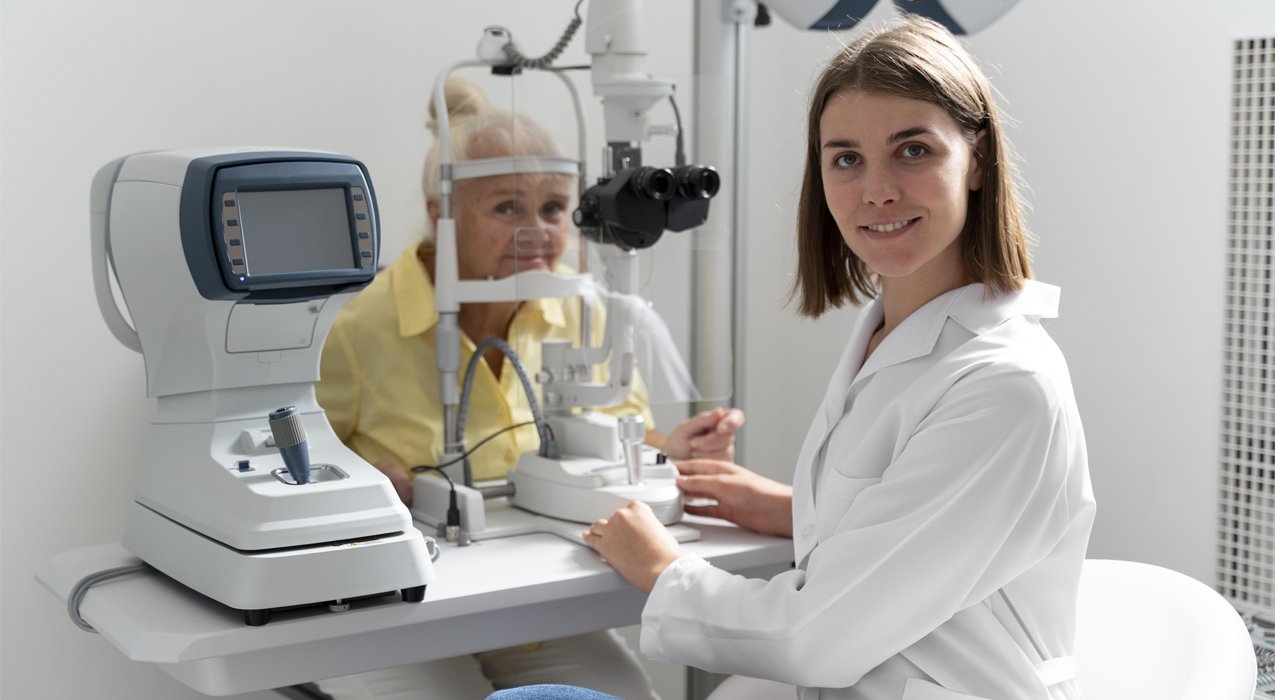
Slit Lamp Biomicroscope: The foundational workstation in any OPD. Available in Haag-Streit (tower illumination) and Zeiss (bottom illumination) configurations, modern slit lamps use parallel Galilean optics and multi-coated Apochromatic lenses to provide flare-free, stereoscopic visualization of corneal and lens pathologies.
Auto Refractometer Keratometer: Combines automated objective refraction with corneal curvature measurement. High-end models integrate Hartmann-Shack wavefront sensors to capture accurate readings even through small pupil diameters (down to 2.0 mm).
Corneal Topographer & Analyzer: Utilizes Placido disc reflection to construct 3D elevation maps of the cornea. Essential for screening subclinical keratoconus prior to refractive surgery (LASIK) and calculating Toric IOL power.
2. Posterior Segment & Retinal Diagnostics
When media opacities (such as mature cataracts or vitreous hemorrhages) block optical inspection, clinicians rely on advanced optical equipment and acoustic imaging.
Ocular Ultrasound (A-Scan / B-Scan): A high-frequency (8 MHz to 11 MHz) b scan machine generates two-dimensional grayscale cross-sections of the vitreous cavity and retina. It is the gold standard for diagnosing retinal detachments, ocular trauma, and choroidal tumors when optical visibility is zero.
Fundus Camera: Captures high-resolution digital photographs of the retina, macula, and optic disc. Non-mydriatic fundus cameras allow rapid screening without requiring pharmacological pupil dilation, making them vital for diabetic retinopathy screening and teleophthalmology.
3. Refraction Suite & OPD Furniture
Efficient patient triaging requires ergonomically designed clinical stations.
Motorized Refraction Units: Integrated chairs and sliding tables that house the phoropter, trial lens set, auto refractometer, and chart projector in a single space-saving footprint.
Trial Lens Sets & Frames: Precision-ground optical trial lenses used by optometrists for subjective refraction verification.
4. Operating Room & Microsurgical Equipment
Surgical suites require extreme mechanical and optical stability.
Operating Ophthalmic Microscope: Features motorized zoom, foot-pedal focus control, variable XY movement, and red-reflex illumination. A high-performance surgical ophthalmic microscope gives surgeons the stereoscopic depth perception needed for cataract phacoemulsification, corneal transplants, and vitrectomy procedures.
Phacoemulsification Consoles: Ultrasonic fluidic systems used to fragment and aspirate cataractous lenses through micro-incisions.
Precision Handheld Ophthalmology Instruments: High-grade stainless steel and titanium micro-instruments—including capsulorhexis forceps, corneal scissors, needle holders, speculums, and cannulas—along with single-use consumable ophthalmic supplies (blades, viscoelastics, suture sets).
Key Clinical Applications Across Ophthalmic Specialties
Modern medical facilities structure their procurement around specific clinical sub-specialties. Aligning ophthalmology instruments with target patient demographics optimizes workflow and maximizes return on investment.
Cataract & Refractive Surgery: Requires high-precision optical biometers, Placido-disc corneal topographers, and operating microscopes equipped with red-reflex technology to ensure accurate IOL power selection and precise incision execution.
Glaucoma Diagnosis & Management: Relies on Goldmann applanation tonometers, non-contact tonometers (NCT), pachymeters (for central corneal thickness correction), and automated visual field analysers (perimeters).
Vitreoretinal Specialty: Requires handheld or table-mounted ophthalmic b scan ultrasound probes, indirect ophthalmoscopes, and digital fundus cameras to manage complex retinal detachments, diabetic retinopathy, and macular degeneration.
Paediatrics & Mobile Outreach: Demands portable eye equipment—such as lightweight handheld slit lamps, wireless portable auto refractometers, and battery-operated handheld B-scan probes—that allow doctors to conduct examinations outside standard hospital rooms.
Strategic B2B Procurement Guide: How to Choose the Right Instruments
Purchasing capital ophthalmic equipment is an ongoing institutional commitment. Making decisions based solely on initial sticker price often leads to high operational downtime, poor optical performance, and unexpected post-warranty costs.
Hospital procurement heads and clinic owners should follow this 5-step evaluation framework:
1. Optical Quality and Engineering Build
Always evaluate the glass quality and mechanical stability of optical diagnostic systems. Multi-coated Apochromatic (APO) lenses eliminate chromatic aberration (color halos around bright objects), delivering true-to-life tissue colors. Check for smooth ball-bearing joystick movements on slit lamps and heavy-duty metallic base assemblies that withstand heavy daily OPD use.
2. Digital Compatibility and DICOM Integration
Isolated diagnostic devices slow down clinical documentation. Ensure that modern devices—such as fundus cameras, B-scans, auto refractometers, and topographers—feature open digital output, Wi-Fi connectivity, and DICOM compliance. This allows images and refractive data to push directly to your Hospital Information System (HIS) or Electronic Health Records (EHR).
3. Open Ecosystems vs. Proprietary Hardware Lock-In
Be cautious of devices that force your facility into proprietary hardware ecosystems. For example, when selecting a wireless portable ultrasound probe, choose systems that support a “Bring Your Own Device” (BYOD) framework. Connecting wirelessly to commercial tablets (iPads or Android tablets) saves substantial capital compared to buying expensive vendor-locked proprietary display monitors.
4. Total Cost of Ownership (TCO) Analysis
Calculate the true lifetime cost of the instrument over a 7-to-10-year period:
Initial CapEx: Purchase price, import duties, freight, and basic accessories.
Operational Expenses: Power consumption, recurring single-use consumables, and software licensing upgrade fees.
Maintenance Infrastructure: Availability and cost of post-warranty Annual Maintenance Contracts (AMC) and Comprehensive Maintenance Contracts (CMC).
5. Vendor Reliability and Regulatory Compliance
Verify that your supplier holds valid CDSCO import/manufacturing licenses, ISO 13485 quality certifications, and direct manufacturer authorizations. Ensure the vendor maintains localized spare parts depots and employs factory-trained biomedical service engineers capable of providing rapid on-site repair dispatch.
Partnering with Mediscience Devices: Your Unrivaled Medical Equipment Supplier
Navigating complex ophthalmic catalogs and securing factory-direct pricing requires more than a generic vendor; it demands a strategic clinical partner. For over 27 years, Mediscience Devices has stood as the undisputed leader in ophthalmic and medical equipment procurement across Eastern and North-Eastern India.
Operating from our regional headquarters in Kolkata, we eliminate the profound operational risks associated with unauthorized drop-shippers and fragmented supply chains. When hospital directors and clinic founders select Mediscience Devices as their single-source procurement partner, they secure a permanent institutional advantage:
Authentic, Factory-Direct Sourcing: As the premier authorized distributor for global engineering leaders like Fujitron, Rexxam, Labomed, and Medivision, we bypass middleman markups. We ensure your capital is invested entirely in pristine optical and acoustic technology, delivering absolute pricing transparency.
End-to-End Turnkey Execution: We manage the entire procurement lifecycle so your clinical staff does not have to. Our factory-trained biomedical engineering team handles pre-installation environmental audits, doorstep delivery, micron-level optical calibration, and comprehensive application training for your doctors and optometrists.
The Zero-Downtime Guarantee: A broken diagnostic device halts patient care and drains hospital revenue. Mediscience protects your facility with ironclad Service Level Agreements (SLAs). We maintain a massive local inventory of spare transducers, circuit boards, illumination modules, and standby loaner units, guaranteeing rapid on-site repair dispatch and uninterrupted OPD operations.
People Also Ask
Diagnostic ophthalmic instruments (such as slit lamps, auto refractometers, fundus cameras, and B-scans) are non-invasive tools used in the OPD to examine eye structures, measure vision, and detect diseases. Surgical instruments (such as operating microscopes, phacoemulsification machines, micro-forceps, and vitrectomy consoles) are sterile tools used in operating rooms to perform invasive procedures like cataract extraction or retinal repair.
Apochromatic (APO) optics focus three wavelengths of light (red, green, and blue) onto the exact same focal plane, whereas standard achromatic optics only align two. This eliminates chromatic aberrations (color fringing halos), delivering high-contrast images, precise depth perception, and true color representation of subtle eye tissues during diagnosis and surgery.
When purchasing a portable eye ultrasound (B-scan), evaluate the transducer frequency (e.g., dual-frequency 8 MHz and 11 MHz for penetration vs. resolution), zero-latency wireless transmission, battery endurance, DICOM connectivity, open tablet compatibility (BYOD), and the local availability of replacement probes and service support.
High-precision diagnostic and surgical devices should undergo professional calibration, optical cleaning, and preventive maintenance at least once or twice a year. High-volume hospital OPDs operating continuous screening bays often schedule quarterly inspections to maintain optical alignment and electronic stability.
Healthcare facilities can source certified, CDSCO-compliant ophthalmic equipment through authorized regional distributors and medical device suppliers. Working with an established distributor guarantees access to genuine factory-warranted instruments, expert installation, staff training, and rapid local technical service support.