Navigating Medical Equipment Procurement: A B2B Buyer’s Guide to Sourcing High-Precision Ophthalmic Equipment in India
Setting up a multi-specialty healthcare facility or expanding a specialized eye hospital requires strategic capital allocation, rigorous regulatory compliance, and a deep understanding of biomedical engineering. In healthcare operations, the quality of your medical equipment directly dictates diagnostic accuracy, surgical outcomes, patient safety, and long-term financial viability.
Procurement directors, Chief Medical Officers (CMOs), and facility administrators often face significant challenges: navigating a fragmented vendor market, managing hidden post-purchase costs, verifying regulatory standards, and ensuring zero clinical downtime. When procuring specialized ophthalmic equipment, these challenges intensify because ocular diagnostics and microsurgery demand micron-level mechanical and optical precision.
Drawing upon over 27 years of industry dominance as a premier medical equipment supplier in India, Mediscience Devices presents this definitive B2B buyer’s guide to streamlining your clinical equipment procurement process and maximizing return on investment (ROI).
The Evolving Landscape of Healthcare Sourcing in India
The Indian healthcare sector is undergoing rapid infrastructure modernization. Tier-1 metros, tier-2, and tier-3 cities are experiencing an influx of private equity investment, expanding hospital chains, and super-specialty eye institutes. Concurrently, government initiatives such as the Ayushman Bharat scheme and national screening programs have significantly increased patient volume across both urban and rural centres.
This market evolution has reshaped how healthcare executives approach clinical equipment procurement:
- From Transactional Buying to Strategic Partnerships: Leading hospitals are moving away from piecemeal, multi-vendor purchasing. Managing separate vendors for slit lamps, operating microscopes, auto refractometers, and ultrasound systems creates logistical friction, fragmented service level agreements (SLAs), and extended downtime. Single-source procurement through an established distributor consolidates accountability.
- Regulatory Rigor: The Central Drugs Standard Control Organisation (CDSCO) under the Ministry of Health and Family Welfare has progressively brought medical devices under strict regulatory frameworks. Ensuring your vendor provides CDSCO-registered, CE-marked, or FDA-approved equipment is now a mandatory risk-mitigation step.
- Demand for Digital Ecosystems: Modern diagnostic equipment can no longer operate in isolation. Facilities require devices that feature DICOM compatibility and integrate directly into Hospital Information Systems (HIS) and Electronic Health Records (EHR) for seamless data transfer and teleophthalmology consultations.
Core Evaluation Criteria for Hospital Procurement Directors
When issuing a Request for Proposal (RFP) or evaluating vendor tenders for medical equipment, procurement heads must look beyond the initial sticker price. A low purchase price often masks high lifetime operational expenses.
Total Cost of Ownership (TCO) vs. Capital Expenditure (CapEx)
Evaluating capital expenditure alone provides an incomplete picture. To calculate the true Total Cost of Ownership over a 7-to-10-year asset lifecycle, procurement committees must evaluate:
- Acquisition Cost: Import duties, freight, insurance, base unit price, and essential accessories.
- Operational Overhead: Power requirements, climate control needs, and recurring single-use or reusable consumables (e.g., applanation prisms, chin-rest papers, calibration eye models).
- Software & Licensing: Upgrade fees, DICOM server connection licenses, and artificial intelligence diagnostic reporting modules.
- Maintenance Contracts: Post-warranty Comprehensive Maintenance Contracts (CMC) or Annual Maintenance Contracts (AMC).
Service Level Agreements (SLAs) and Uptime Guarantees
Equipment downtime in an Outpatient Department (OPD) or Operating Theater (OT) leads directly to lost clinical revenue, delayed surgeries, and compromised patient trust. An institutional SLA with a medical equipment supplier in India must guarantee:
- Response Time: On-site technician dispatch within 24 hours for metro areas and within 48 hours for regional locations.
- Uptime Threshold: A minimum guaranteed uptime of 95% to 98% per annum.
- Buffer Stock Availability: Access to temporary replacement units or critical spare parts depots to prevent clinical suspension during complex repairs.
The Precision Threshold: Why Ophthalmic Equipment Demands Specialized Sourcing
While general medical equipment—such as patient monitors, infusion pumps, or hospital beds—focuses on structural durability and standardized electronic monitoring, ophthalmic equipment belongs to a distinct class of precision bio-optics and laser systems.
Micron-Level Optical & Mechanical Tolerances
Ophthalmic surgical and diagnostic tools operate within micron-scale tolerances:
- Slit Lamp Biomicroscopes: Require apochromatic glass coatings to eliminate chromatic aberration (color fringing) when inspecting delicate corneal layers or posterior capsule opacities.
- Auto Refractometers: Utilize Hartmann-Shack wavefront sensing technology to measure light reflection off the retina through pupils as small as 2.0mm.
- Operating Microscopes: Require precise red-reflex illumination, high-depth stereoscopic optics, and smooth motorized zoom mechanisms to ensure safety during phacoemulsification or vitrectomy.
A minor misalignment during transit or improper installation can skew diagnostic values or degrade surgical visualization. Therefore, procuring eye hospital equipment requires specialized handling, precision optical alignment, and environmental calibration that generic medical distributors cannot provide.
Master Equipment Matrix: Outfitting a Modern Eye Hospital
To streamline facility planning, the following matrix outlines the primary categories of ophthalmic equipment required across different hospital departments, along with key procurement specifications:
Department | Essential Equipment Category | Key Procurement Specifications | Recommended Benchmark Models |
OPD Screening | Auto-fogging target, Hartmann-Shack wavefront sensing, minimum 2.0mm pupil reading, auto-pachymetry option. | Visionix VX 90 / REXXAM R-800 | |
Anterior Diagnostic | Slit Lamp Biomicroscope | Galilean parallel optics, 5-step drum magnification (6x–40x), tower (Haag-Streit style) illumination, LED light source, beam splitter ready. | Labomed SLx Series / Fujitron FSL-355H |
Retinal Screening | Non-mydriatic imaging, minimum 12MP sensor, auto-focus/fixation, handheld portable options (for outreach/pediatrics) or ultra-widefield 200° systems. | ||
Glaucoma & Pressure | Non-Contact Tonometer (NCT) for triage screening + Goldmann Applanation Tonometer (GAT) mounted on slit lamp for clinical verification. | ||
Ocular Ultrasound | High-frequency probes (10MHz–20MHz), wireless Bluetooth/Wi-Fi tablet connectivity, high-definition cine-loop storage, immersion vector A-scan. | ||
Surgical Suite (OT) | Ophthalmic Operating Microscope | Apochromatic optics, motorized focusing/zoom, high-contrast red-reflex illumination, co-observation port, cold LED lighting. | |
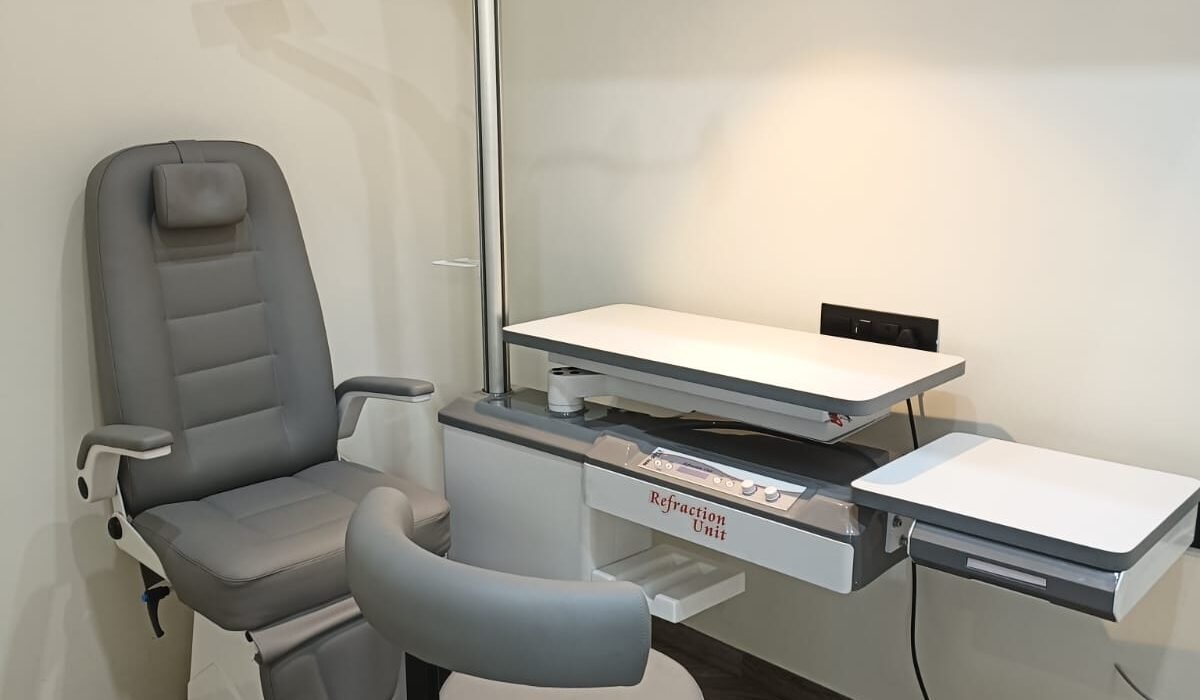
Clinical Ergonomics | Ophthalmic Refraction Units | Motorized chair elevation, sliding double-instrument tabletop, centralized master control panel, near-vision arm. | Medivision MOU-2000 Chair Unit |
Vendor Vetting Checklist: Selecting a Reliable Medical Equipment Supplier in India
Before issuing purchase orders, hospital procurement committees should run prospective suppliers through this comprehensive vetting checklist:
Regulatory & Corporate Compliance
- CDSCO Registration: Does the supplier hold valid CDSCO import/manufacturing licenses for the quoted equipment?
- Quality Certifications: Is the vendor ISO 9001 (Quality Management) and ISO 13485 (Medical Devices) certified?
- Manufacturer Authorization: Is the supplier an authorized distributor backed directly by global original equipment manufacturers (OEMs)?
Technical Infrastructure & Service Capability
- Biomedical Engineering Team: Does the distributor employ full-time, factory-trained service engineers rather than outsourced third-party contractors?
- Local Spare Parts Depot: Does the vendor maintain an inventory of critical replacement parts (e.g., optical prisms, power supplies, LED modules, motherboard circuits) within your region?
- Application & Staff Training: Does the contract include comprehensive, on-site clinical application training for your optometrists, technicians, and nursing staff?
Installation & Environmental Readiness
- Site Inspection: Will the vendor conduct pre-installation site visits to assess electrical grounding, voltage stabilization, dust control, and room dimensions?
- Calibration Certification: Does the vendor provide an official Calibration and Quality Assurance Certificate upon installation?
Medical Equipment Maintenance and Calibration: Mitigating Risk
Procuring high-end devices is only the first step; maintaining optical and electronic fidelity over time requires a structured maintenance regimen. Over time, factors such as environmental dust, humidity, voltage fluctuations, and mechanical wear can introduce subtle diagnostic errors.
Preventive Maintenance vs. Reactive Repair
Relying strictly on reactive repairs when a machine breaks down is an expensive strategy. A robust medical equipment maintenance and calibration protocol should include:
- Optical Alignment Checks: Inspecting beam splitters, prisms, and eyepieces for alignment and signs of fungal growth common in humid tropical climates.
- Pressure Standardization: Verifying applanation tonometer force-springs against standardized calibration weight bars to ensure accurate intraocular pressure (IOP) readings.
- Power & Voltage Stabilization: Testing internal transformers and switch-mode power supplies (SMPS) to prevent electronic board failure caused by power surges.
- Software & Firmware Updates: Upgrading device software to maintain DICOM connectivity standards and access improved image-processing algorithms.
Partnering with Mediscience Devices: 27+ Years of Healthcare Procurement Excellence
Navigating the complexities of medical equipment sourcing requires a supply partner with a proven institutional track record. Founded in 1997, Mediscience Devices has established itself as a premier supplier, importer, and service provider of optometry and ophthalmic equipment across Eastern and North-Eastern India, including West Bengal, Jharkhand, Odisha, Assam, Nagaland, Mizoram, Manipur, and Chhattisgarh.
The Mediscience Institutional Advantage
- Institutional Experience: We regularly supply private eye institutes, corporate healthcare chains, government medical colleges, military hospitals (BSF, HAL), public sector undertakings (NTPC, IOC, BCCL), and non-governmental charitable organizations (Rotary, Lions Club).
- End-to-End Turnkey Execution: From initial spatial layout planning and site inspection to equipment delivery, doorstep installation, application training, and long-term warranty support, Mediscience manages the entire procurement lifecycle.
- Hybrid Supply Flexibility: We offer customized procurement packages—combining top-tier imported optical heads (e.g., Takagi, Labomed, Fujitron, Optos) with heavy-duty, indigenous clinical infrastructure (Medivision motorized chair units and tables)—providing maximum optical quality while optimizing capital budgets.
- Unwavering Service Infrastructure: Headquartered in Kolkata with strategically distributed service hubs, our network of factory-trained biomedical engineers ensures rapid response times and minimal clinical downtime.
Streamlining Your Hospital Sourcing Today
Modernizing your hospital infrastructure or building a new eye care center is a transformative venture. By prioritizing total cost of ownership, regulatory compliance, optical precision, and structured medical equipment maintenance and calibration, hospital leadership can build a high-performing, financially sustainable clinical facility.
Partnering with an established, single-source medical equipment supplier in India like Mediscience Devices eliminates vendor management friction, safeguards capital investments, and empowers your clinical staff to deliver superior patient outcomes.
Are you planning a new hospital project, upgrading an existing OPD, or issuing an equipment tender? Contact the B2B procurement team at Mediscience Devices today to request technical catalogues, site-readiness evaluations, or customized price quotes.
Frequently Asked Questions (FAQ)
When procuring medical equipment in India, ensure the devices are CDSCO-registered (under the Medical Devices Rules) and comply with international quality benchmarks such as ISO 13485 (Medical Device Quality Management), ISO 9001, and CE or US-FDA approvals. Equipment suppliers should also hold valid trade and import licenses.
An Annual Maintenance Contract (AMC) covers routine preventive maintenance visits, labor, and technical service calls, but excludes the cost of replacement spare parts. A Comprehensive Maintenance Contract (CMC) covers everything included in an AMC plus the full cost of replacing defective hardware, electronic circuit boards, and major components, offering complete risk protection for high-value assets.
Single-source procurement allows eye hospitals to consolidate vendor management under one primary supplier. This lowers acquisition costs through bundled packages, ensures seamless compatibility between instruments (e.g., motorized tables, slit lamps, tonometers, and refraction units), standardizes service level agreements (SLAs), and provides a single point of contact for routine maintenance and calibration.
High-precision ophthalmic equipment—such as applanation tonometers, auto refractometers, fundus cameras, and optical biometers—should undergo professional calibration and preventive maintenance at least once a year. High-volume hospitals operating round-the-clock diagnostic bays often schedule bi-annual calibration audits.
Mediscience Devices, headquartered in Dhakuria, Kolkata, is one of the most established importers, suppliers, and service providers of optometry and ophthalmic equipment in Eastern and North-Eastern India. With over 27 years of experience, they serve government health departments, private hospitals, medical colleges, and individual specialists across West Bengal, Assam, Jharkhand, Odisha, Chhattisgarh, and the North-Eastern states.