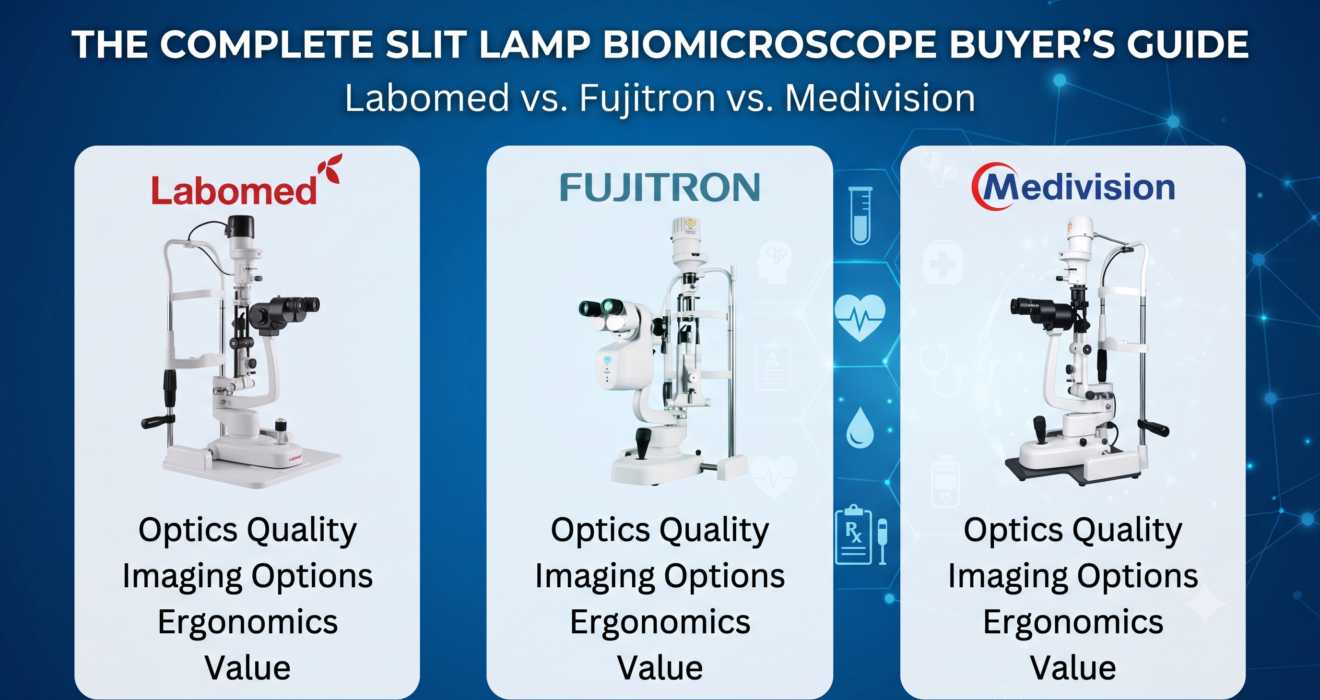
The Complete Slit Lamp Biomicroscope Buyer’s Guide: Labomed vs. Fujitron vs. Medivision
In any ophthalmic Outpatient Department (OPD), the slit lamp biomicroscope is not merely one item on a long equipment checklist—it is the single most critical diagnostic workstation in the clinic. From evaluating subtle corneal dystrophies and tear film break-up times to scoring nuclear cataracts, measuring intraocular pressure, and visualizing the posterior pole with high-index lenses, a doctor spends hours behind the eyepieces every single day.
Despite its ubiquity, purchasing an ophthalmic slit lamp remains one of the most complex capital expenditure decisions for hospital directors and practicing eye care professionals. The Indian market presents a vast spectrum of options: imported European and Japanese optical heads, high-end digital imaging systems, budget-friendly indigenous units, and mobile handheld models.
Making an uneducated choice can lead to severe clinical bottlenecks, eye fatigue, misdiagnosed pathologies, and frequent mechanical misalignment.
Drawing upon over 27 years of industry leadership as a premier importer, supplier, and service provider across Eastern and North-Eastern India, Mediscience Devices provides this definitive technical buyer’s guide. We break down optical physics, mechanical architectures, model comparisons, and the true slit lamp biomicroscope price in India to help you select the exact instrument for your clinical workflow.
1.The Physics of Ophthalmic Optics: Galilean vs. Converging Systems
When evaluating a haag streit type slit lamp, the first technical fork in the road is the design of the binocular observation tube and the magnification changer.
                  ┌─────────────────────────────────────────┐
                  │      Slit Lamp Optical Architectures    │
                  └────────────────────┬────────────────────┘
                                       │
            ┌──────────────────────────┴──────────────────────────┐
            ▼                                                     ▼
┌───────────────────────────────┐                     ┌───────────────────────────────┐
│     Galilean Optics           │                     │     Converging Optics         │
│  (Parallel Optical Paths)     │                     │  (Angled Optical Paths)       │
├───────────────────────────────┤                     ├───────────────────────────────┤
│ • Parallel beams to eyepieces │                     │ • Eyes converge inward (13°)  │
│ • Reduces neck & eye strain   │                     │ • Natural stereoscopic depth  │
│ • Ideal for long OPD hours    │                     │ • Cost-effective 2-step setup │
│ • Easy beam splitter mounting │                     │ • Common in entry-level OPDs  │
└───────────────────────────────┘                     └───────────────────────────────┘
Galilean (Parallel) Optical Systems
A galilean slit lamp utilizes parallel optical paths. The light emerging from the magnification changer travels in parallel rays before reaching the eyepieces.
Clinical Benefit: Because your eyes look straight ahead without forcing internal convergence, Galilean systems dramatically reduce accommodation fatigue during 6-to-8-hour OPD sessions.
Modularity: Parallel optics allow seamless mounting of accessories—such as beam splitters, co-observation tubes, digital DSLR camera adapters, and yellow barrier filters—without introducing optical distortion.
Featured Models: Found in premium series such as the Labomed SLx40/SLx45 and the Fujitron FSL-355H.
Converging Optical Systems
Deciding between a traditional tabletop ARK and a portable auto refractometer is not always an “either/or” choice. For high-volume, multi-specialty hospitals, the ideal setup involves utilizing both.
The Tabletop ARK serves as the anchor of the main optometry bay, providing highly detailed, reproducible data for adult patients preparing for refractive or cataract surgeries.
The Portable Auto Refractometer acts as an agile auxiliary tool, specifically deployed in the pediatric wing, the mobile screening unit, and for patients with physical disabilities.
Apochromatic vs. Achromatic Lenses
Standard achromatic optics correct chromatic aberration (color fringing) at two wavelengths of light. However, under the intense illumination of a slit lamp, blue and red fringes can obscure delicate anterior segment structures.
High-end slit lamps utilize apochromatic (APO) optics, which bring three wavelengths of light into the exact same focal plane. This eliminates color halos, providing true-to-life color rendering when evaluating anterior chamber flare, corneal endothelium cells, or optic nerve head rim pallor.
2. Illumination Architecture: Tower (Haag-Streit) vs. Lower (Zeiss) Systems
The physical position of the slit illumination column determines the versatility of your examination.
                          ┌───────────────────────────┐
                          │   Illumination Systems    │
                          └─────────────┬─────────────┘
                                        │
           ┌────────────────────────────┴────────────────────────────┐
           ▼                                                         ▼
┌──────────────────────────────────────┐  ┌──────────────────────────────────────┐
│     Tower (Haag-Streit Type)         │  │     Lower (Zeiss Type)               │
├──────────────────────────────────────┤  ├──────────────────────────────────────┤
│ • Light source mounted ABOVE optics  │  │ • Light source mounted BELOW optics  │
│ • Full 0° to 180° continuous sweep   │  │ • Fixed vertical illumination shaft  │
│ • Tilting slit column (up to 20°)    │  │ • Compact vertical footprint         │
│ • Superior for Gonioscopy & Scleral  │  │ • Preferred by some posterior pole   │
│   Scatter                            │  │   specialists                        │
└──────────────────────────────────────┘  └──────────────────────────────────────┘
Tower Illumination (Haag-Streit Style)
In a tower system, the light source is positioned above the optical observation system. The slit can be swivelled continuously from 0° to 180° horizontally, and the column can be tilted vertically in increments up to 20°.
Why It Dominates: Vertical inclination is indispensable for scleral scatter techniques, retro-illumination of lens opacities, and performing gonioscopy without reflection artifacts. Furthermore, Haag-Streit style towers serve as the mounting point for Goldmann-style applanation tonometers.
Lower Illumination (Zeiss Style)
In Zeiss-style systems, the light source is housed in the base column below the optical axis. While compact and ergonomically familiar to retina specialists performing vitreoretinal evaluations with 90D or 78D lenses, it lacks the vertical slit-tilting capability required for specialized corneal work.
3. Detailed Model Matrix: Labomed vs. Fujitron vs. Medivision
To choose the best ophthalmic slit lamp for your practice, consider how these three leading brands compare across build quality, optical performance, and clinical specialization.
| Feature / Model | Labomed SLx 45 / SLx 40 | Fujitron FSL-355H-SOS (Studio) | Medivision MSL-2000HD | Fujitron PFSL-2X (Portable) |
| Optical System | Galilean (Parallel) | Galilean (Parallel) | Converging Optics | Handheld Galilean |
| Magnification | 3-Step or 5-Step Drum | 5-Step Revolving Drum | 2-Step / 3-Step Lever | 2-Step Flip Lever |
| Magnification Ratios | 6x, 10x, 16x, 25x, 40x | 6x, 10x, 16x, 25x, 40x | 10x, 16x (or 10x, 16x, 25x) | 10x, 16x |
| Illumination Type | Tower (Haag-Streit Style) | Tower (Haag-Streit Style) | Tower (Haag-Streit Style) | Handheld High-Lumen LED |
| Light Source | Halogen / High-Luminance LED | Cold LED / Halogen Hybrid | Halogen / LED | Rechargeable Li-ion LED |
| Coating Tech | maxLite™ Anti-Reflective | Swiss Multi-Coated | Anti-Fungal Hard Coat | Multi-Coated Anti-Glare |
| Digital Ready | Optional Beam Splitter | Integrated DSLR Beam Splitter | External Mount Optional | Mobile Phone Camera Mount |
| Primary Specialty | High-End OPD & Cornea | Teaching Hospitals & EHR | Standard High-Volume OPD | Pediatrics & Mobile Camps |
The Premium Tier: Labomed SLx 40 & SLx 45
The Labomed slit lamp range represents engineering excellence for clinicians who refuse to compromise on optical clarity.
       ┌────────────────────────────────────────────────────────┐
       │                 Labomed SLx 45 / SLx 40                │
       └───────────────────────────┬────────────────────────────┘
                                   │
      ┌────────────────────────────┼────────────────────────────┐
      ▼                            ▼                            ▼
┌──────────────────────────┐ ┌──────────────────────────┐ ┌──────────────────────────┐
│   Galilean Apochromatic  │ │   maxLite™ Anti-Reflect │ │   Precision Fluid-Motion │
│   5-Step Drum Optics     │ │   Multicoated Lenses     │ │   Mechanical Base        │
└──────────────────────────┘ └──────────────────────────┘ └──────────────────────────┘
Optical Excellence: Built with an Apochromatic Galilean optical system, the SLx series delivers high-contrast imaging without color halos. Lenses are treated with Labomed’s proprietary maxLite™ anti-reflective coatings, maximizing light transmission and eliminating internal reflections even under high LED intensity.
Mechanical Fluidity: The cross-slide joystick mechanism uses precision ball bearings, enabling smooth single-handed maneuvering in the X, Y, and Z axes.
Illumination Options: The SLx 45 features a tower illumination system with a built-in yellow barrier filter, ideal for fluorescein staining analysis in dry eye evaluation and rigid contact lens fitting.
Verdict: The premier choice for corneal specialists, refractive surgeons, and premium private practices seeking long-term optical reliability.
The Digital Imaging Powerhouse: Fujitron FSL-355H-SOS (Studio-DSLR)
For clinics that prioritize objective patient documentation, teleophthalmology, and medical teaching, the Fujitron FSL-355H-SOS stands out as a high-performance imaging workstation.
       ┌────────────────────────────────────────────────────────┐
       │             Fujitron FSL-355H-SOS (Studio)             │
       └───────────────────────────┬────────────────────────────┘
                                   │
      ┌────────────────────────────┼────────────────────────────┐
      ▼                            ▼                            ▼
┌──────────────────────────┐ ┌──────────────────────────┐ ┌──────────────────────────┐
│   Integrated DSLR Beam   │ │   High-Intensity Cold    │ │   5-Step Drum Mag        │
│   Splitter Module        │ │   LED Lighting System    │ │   (Up to 40x Detail)     │
└──────────────────────────┘ └──────────────────────────┘ └──────────────────────────┘
High-Resolution Photography: Features an integrated optical beam splitter and camera adapter module designed for high-resolution DSLR sensors. Captures still images and 4K videos of anterior segment pathologies for patient counseling and Electronic Health Record (EHR) integration.
5-Step Magnification Drum: Switch seamlessly between 6x (wide screening view), 10x, 16x, 25x, and 40x (detailed corneal endothelial and lens capsule inspection).
Swiss Multi-Coated Optics: Designed with high light-transmission glass, ensuring bright images even when light is split toward the camera sensor.
Verdict: An exceptional option for multi-specialty eye hospitals, academic institutes, and clinics that rely on visual patient education to drive surgical consent.
The High-Volume Workhorse: Medivision MSL-2000HD
Not every consultation station requires an expensive digital setup. High-volume hospitals need reliable, cost-effective screening tools.
       ┌────────────────────────────────────────────────────────┐
       │                 Medivision MSL-2000HD                  │
       └───────────────────────────┬────────────────────────────┘
                                   │
      ┌────────────────────────────┼────────────────────────────┐
      ▼                            ▼                            ▼
┌──────────────────────────┐ ┌──────────────────────────┐ ┌──────────────────────────┐
│   Converging Optics      │ │   Heavy-Duty Metal       │ │   Ideal Cost-To-Value    │
│   (2-Step / 3-Step)      │ │   Base Assembly          │ │   Ratio for Mass OPD     │
└──────────────────────────┘ └──────────────────────────┘ └──────────────────────────┘
Rugged Construction: Engineered with a heavy-duty metallic base and high-durability gear tracks designed to handle hundreds of patient adjustments daily.
Optical Efficiency: Utilizes a converging optical path with a 2-step (10x, 16x) or 3-step magnification lever. Delivers crisp, high-contrast views suitable for general OPD screenings, cataract assessments, and post-operative evaluations.
Maintenance Ease: Designed with accessible illumination modules, making halogen/LED replacement simple for internal engineering teams.
Verdict: The ideal budget-friendly workhorse for secondary OPD stations, government health tenders, and charitable trust hospitals.
Mobile & Outpatient Diagnostics: Fujitron Portable Handheld Slit Lamp (PFSL-2X)
When the patient cannot come to the slit lamp table, a portable slit lamp brings the examination room directly to the patient.
       ┌────────────────────────────────────────────────────────┐
       │            Fujitron Portable Slit Lamp PFSL-2X          │
       └───────────────────────────┬────────────────────────────┘
                                   │
      ┌────────────────────────────┼────────────────────────────┐
      ▼                            ▼                            ▼
┌──────────────────────────┐ ┌──────────────────────────┐ ┌──────────────────────────┐
│   Lightweight Handheld   │ │   High-Lumen Recharge    │ │   Pediatric & Bedridden  │
│   Ergonomic Design       │ │   Lithium-Ion LED        │ │   Clinical Utility       │
└──────────────────────────┘ └──────────────────────────┘ └──────────────────────────┘
Clinical Independence: Weighing under 800 grams, the PFSL-2X features a long-lasting rechargeable Lithium-ion battery, high-luminance LED illumination, and a 2-step magnification system (10x, 16x).
Slit Versatility: Offers adjustable slit widths (0mm to 12mm), continuous slit length adjustments, and built-in cobalt blue, green (red-free), and heat-absorption filters.
Verdict: Mandatory for pediatric care, examining bedridden ward patients, emergency rooms, veterinary ophthalmology, and rural screening camps.
4. Diagnostic Synergy: Integrating Goldmann-Style Applanation Tonometry
A slit lamp reaches its full diagnostic potential when paired with an applanation tonometer.
┌─────────────────────────────────────────────────────────────────────────┐
│                    Slit Lamp + Tonometry Integration                    │
└────────────────────────────────────┬────────────────────────────────────┘
                                     │
                 ┌───────────────────┴───────────────────┐
                 ▼                                       ▼
┌─────────────────────────────────┐     ┌─────────────────────────────────┐
│  Tower Mounted (T-Type)         │     │  Post Mounted (R-Type)          │
├─────────────────────────────────┤     ├─────────────────────────────────┤
│ • Swings down in front of optics│     │ • Fixed to a post on the base   │
│ • Mounts on top of the tower    │     │ • Swings into place from side   │
│ • Gold standard for Glaucoma    │     │ • Stays clear of optics when    │
│   IOP measurement               │     │   not in active use             │
└─────────────────────────────────┘     └─────────────────────────────────┘
Goldmann Applanation Tonometry (GAT) remains the global reference standard for measuring Intraocular Pressure (IOP). When outfitting a Haag-Streit style tower slit lamp, clinicians can select between two tonometer mounting styles:
T-Type (Tower Mounted): The tonometer base mounts directly atop the illumination tower guide plate. When IOP measurement is required, the unit swings down smoothly in front of the objective lens.
R-Type (Post Mounted): The tonometer is mounted on a dedicated post attached to the microscope’s central axis base, swinging into the optical path from the side.
The Fujitron Applanation Tonometer (FAT-T170)
Proudly supplied by Mediscience Devices, the FAT-T170 mounts seamlessly onto Haag-Streit style slit lamps (such as the Labomed SLx and Fujitron FSL series).
Featuring a high-precision internal force-spring assembly and an optical acrylic prism, the FAT-T170 delivers repeatable, clinical-grade IOP readings without calibration drift, making it an essential add-on for any comprehensive glaucoma practice.
5. Deconstructing the Slit Lamp Price in India: TCO & ROI Analysis
When evaluating quotes from vendors, looking solely at the base slit lamp biomicroscope price in India can be misleading. To understand the true investment, you must analyze the Total Cost of Ownership (TCO) over a 10-year period.
┌─────────────────────────────────────────────────────────────────────────┐
│              Total Cost of Ownership (TCO) Components                   │
└────────────────────────────────────┬────────────────────────────────────┘
                                     │
    ┌────────────────┬───────────────┴───────────────┬────────────────┐
    ▼                ▼                               ▼                ▼
┌──────────────┐ ┌──────────────┐               ┌──────────────┐ ┌──────────────┐
│  Base Price  │ │ Accessories  │               │ Calibration  │ │  Downtime    │
│ (Optics/Base)│ │ (Tonometers) │               │ & Maintenance│ │ (Part Availability)
└──────────────┘ └──────────────┘               └──────────────┘ └──────────────┘
Key Factors Driving Capital Cost:
Optical Glass Quality: Standard achromatic lenses vs. premium imported Apochromatic (APO) optics with multi-layer coatings (e.g., maxLite™).
Magnification Engineering: Simple 2-step flip levers are more affordable, whereas precision 5-step Galilean drums require complex gear assemblies that increase initial cost but offer superior clinical versatility.
Illumination Technology: Legacy Halogen bulbs require frequent replacements and generate heat. Modern cold LED illumination increases upfront costs slightly but lasts up to 50,000 hours while reducing energy consumption.
Digital Hardware Integration: Models equipped with beam splitters, camera adapters, and DSLR synchronization software sit at a higher price tier due to their optical engineering.
The Hidden Cost of Low-Quality Procurement
Purchasing an unbranded or poorly supported slit lamp may save upfront capital, but it introduces major long-term expenses:
Fungus and Coating Degradation: In tropical climates across Eastern India, sub-standard lens coatings lack anti-fungal treatments, leading to optical fogging within 18–24 months.
Mechanical Drift & Play: Lower-grade joystick and track assemblies develop mechanical play over time, making subtle focusing on corneal layers frustrating and slow.
Service Downtime: A broken slit lamp stalls an entire consultation line. Generic importers often lack local spare parts (e.g., replacement bulbs, reflection prisms, joystick gears), leading to weeks of operational downtime.
6. The Mediscience Advantage: 27+ Years of Industry Dominance
Buying a slit lamp is not an isolated transaction; it is the start of a long-term service relationship. As one of Eastern and North-Eastern India’s most established suppliers and service providers, Mediscience Devices brings unparalleled support to your practice.
┌─────────────────────────────────────────────────────────────────────────┐
│                      The Mediscience Guarantee                          │
└────────────────────────────────────┬────────────────────────────────────┘
                                     │
    ┌────────────────┬───────────────┴───────────────┬────────────────┐
    ▼                ▼                               ▼                ▼
┌──────────────┐ ┌──────────────┐               ┌──────────────┐ ┌──────────────┐
│ Hybrid Custom│ │ Factory-Trained│              │ Local Spare  │ │ 1-Year On-Site│
│ Configurations││ Installation │               │ Parts Depot  │ │ Warranty     │
└──────────────┘ └──────────────┘               └──────────────┘ └──────────────┘
Hybrid Custom Configurations: Mediscience offers specialized hybrid setups—such as mounting imported optical heads (Labomed or Fujitron) onto heavy-duty Medivision motorized tables—providing premium optical quality at an optimized price point.
Factory-Trained Service Engineers: Based in Kolkata with a service network reaching Chhattisgarh, West Bengal, Jharkhand, Assam, and Nagaland, our technicians handle on-site installation, optical alignment, and periodic maintenance.
Spare Parts Depot: We maintain a stock of original lamps, tonometry prisms, chin-rest papers, and electronic boards, guaranteeing rapid resolution if service is required.
Comprehensive Warranties: Every slit lamp supplied by Mediscience comes backed by a standard 1-year comprehensive on-site warranty, with optional Annual Maintenance Contracts (AMC) to safeguard your investment for decades.
7. Conclusion: Making Your Procurement Decision
Selecting the right ophthalmic slit lamp comes down to aligning your clinical requirements with your operational budget:
Choose the Labomed SLx 40/45 if you require apochromatic optical performance, fluid mechanical controls, and maximum optical longevity for specialized corneal and refractive practice.
Choose the Fujitron FSL-355H-SOS if you need high-definition digital imaging for patient education, teaching, and EHR integration.
Choose the Medivision MSL-2000HD if you need a durable, cost-effective workhorse for high-volume secondary OPD screening bays.
Choose the Fujitron PFSL-2X if you need a mobile screening tool for pediatrics, ward visits, and outreach eye camps.
Ready to upgrade your consultation suite? Contact the equipment specialists at Mediscience Devices today to request a demo, product catalog, or customized price quote.
Frequently Asked Questions (FAQ)
A Galilean slit lamp uses parallel optical paths, allowing the doctor to observe the eye without forcing internal eye convergence, significantly reducing fatigue during long OPD hours. A converging slit lamp uses angled optical paths (usually 13 degrees), offering a pronounced stereoscopic view at a lower cost, making it popular for standard screening stations.
Apochromatic (APO) lenses bring three wavelengths of light into the exact same focus plane, whereas standard achromatic lenses only align two. This eliminates chromatic aberrations (color fringing halos around bright objects), allowing clinicians to see true-to-life color and fine details in corneal layers or anterior chamber flare.
Not all slit lamps support digital camera integration. To attach a digital camera or DSLR, the slit lamp must have a Galilean (parallel) optical system and a beam splitter module. Models like the Fujitron FSL-355H-SOS come equipped with built-in camera adapters for high-resolution imaging.
Goldmann-style applanation tonometers (such as the Fujitron FAT-T170) typically mount onto Haag-Streit style tower slit lamps. T-Type tonometers mount on top of the illumination tower guide plate and swing down into position, while R-Type tonometers attach to a central post on the base assembly and swing in from the side.
Mediscience Devices, headquartered in Dhakuria, Kolkata, is a leading authorized importer and distributor of Labomed, Fujitron, and Medivision slit lamps. Serving Eastern and North-Eastern India for over 27 years, they offer full installation, calibration, and on-site warranty support.