Introduction: The Diagnostic Role of the Auto Lensmeter in Modern Eye Care
The optical diagnostic and spectacle dispensing workflow relies on precise objective verification. Whether in a busy ophthalmic hospital, a clinical outpatient department (OPD), an optical retail showroom, or a specialized lens manufacturing laboratory, accurately verifying a lens’s optical prescription is critical to patient satisfaction.
A manual lensmeter (focimeter) relies heavily on operator technique, eye positioning, and manual alignment of target crosshairs. This can introduce human error, particularly when verifying complex progressive addition lenses (PALs), high-index optics, or prism prescriptions.
Transitioning to an automated auto lensmeter eliminates operator variability. By integrating multi-channel sensor arrays, high-speed microprocessors, and automated lens edge detection, a modern digital lensmeter calculates spherical power, cylindrical power, cylinder axis, addition (ADD) power, and prism deviation within seconds.
For clinical managers, optical entrepreneurs, and B2B equipment distributors, evaluating an auto lensmeter price proposal requires looking beyond the basic hardware quote. Key features to evaluate include optical sensor resolution, UV/Blue light transmission testing capabilities, progressive lens recognition algorithms, and long-term after-sales support.
This comprehensive guide breaks down wavefront and Hartmann sensor optics, compares leading models in Mediscience Devices’ auto lensmeter category, analyzes commercial investment tiers, and outlines how sourcing through Mediscience streamlines procurement across India and international markets.
Understanding Auto Lensmeter Technology: Hartmann Sensors & Wavefront Measurement
An auto lensmeter projects a specific light beam—typically a green LED light engine operating at a 525 nm wavelength to eliminate Abbe value manual adjustments—through the spectacle or contact lens onto a sensor array.
Key Technical Advantages of Automated Measurement:
Hartmann Sensor Array Technology: Utilizing 100 to 145 discrete measurement points across the lens matrix, a digital lensmeter maps multi-focal zones instantaneously, automatically recognizing whether a lens is a single-vision, bifocal, or progressive optic.
Green LED Light Engine (525 nm): Traditional red light sources required manual compensation for high-index materials with varying Abbe numbers. Green LED engines ensure accurate refractive readings regardless of lens material (CR-39, Polycarbonate, Trivex, 1.67, or 1.74 High Index).
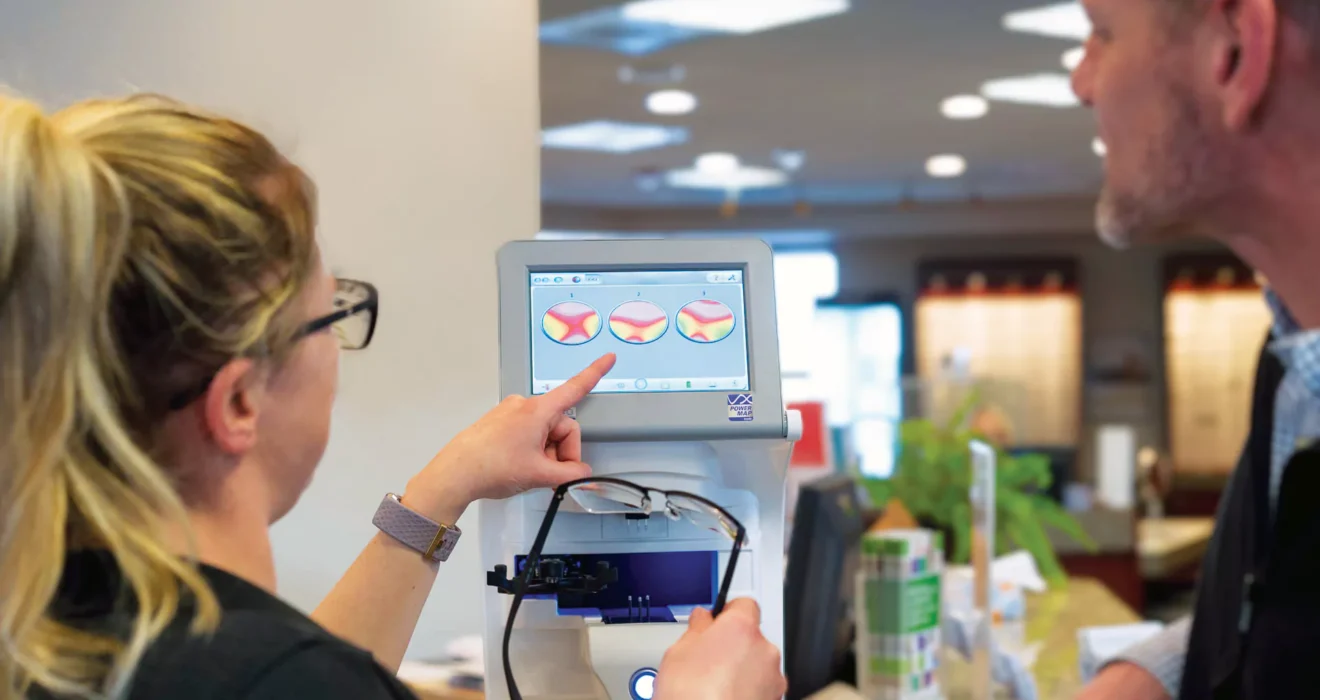
Automated Progressive Lens Recognition: When measuring progressive addition lenses (PALs), the system detects the distance reference point (DRP) and near reference point (NRP), displaying directional guidance arrows on-screen to guide the operator.
Spectacle Lens Coating Analysis: Modern units feature built-in UV and High-Energy Visible (HEV) Blue Light transmission sensors, allowing optical dispensers to demonstrate coating efficacy to patients directly on-screen.
Detailed Product Portfolio: Featured Auto Lensmeter Models
Selecting the best auto lensmeter depends on your practice’s daily patient volume, spatial constraints, and required technical feature set. Mediscience Devices supplies a comprehensive selection of top-performing models:
A. High-Precision Clinical Workstations
Category Focus: Fast, Dependable OPD & Retail Workhorse
Key Features: High-speed measurement processing, high-contrast display interface, robust mechanical marking pen assembly, and small-diameter lens measurement support.
Clinical Target: Excellent for high-volume optical retail outlets, busy hospital OPD dispensing desks, and general optometry clinics looking for consistent daily lens verification.
2. Mars Medica Digital Auto Lensmeter Model MAL-100
Category Focus: Compact Digital Measurement Console
Key Features: High-definition digital screen, intuitive user interface, progressive lens identification, and built-in thermal report printing.
Clinical Target: Designed for growing eye clinics, secondary hospitals, and optical laboratories seeking a user-friendly digital lensmeter footprint.
B. Advanced Touchscreen & Multi-Sensor Workstations
3. I-Optik Auto Lensmeter TL-6800
Category Focus: Advanced Hartmann Sensor Platform with UV/Blue Light Testing
Key Specifications: 145 discrete Hartmann measurement points, 7.0-inch color touch display with adjustable tilt angle, full UV and Blue Light spectrum transmission analysis, dark sunglass measurement down to 5% transmittance, and built-in thermal printer with RS-232, USB, and LAN export capability.
Clinical Target: High-volume optical practices, labs, and surgical centers requiring comprehensive coating verification alongside refraction data.
Category Focus: High-Speed OPD & Laboratory Workstation
Key Features: Compact chassis, high-resolution color LCD, fast automatic progressive recognition, and smooth lens marking mechanics. Evaluating the matrix lensmeter price structure reveals an accessible capital expenditure profile for multi-lane facilities.
Clinical Target: High-volume outpatient dispensing bays, corporate optical chains, and clinical labs requiring rapid, repeatable measurement routines.
C. Flagship Japanese Engineering (Shin-Nippon / Rexxam)
5. Shin-Nippon AL Digital Lensmeter 1000
Category Focus: Premium Japanese Optical Engineering & High-Precision Diagnostics
Key Features: Manufactured in Japan, featuring precision optical sensors, a wide measurement range, a smooth mechanical lens clamp, and high structural durability.
Clinical Target: Institutional teaching hospitals, university research departments, and premium ophthalmic centers requiring top-tier Japanese optics.
6. Shin-Nippon Digital Lensmeter DL-900
Category Focus: High-End Ergonomic Workstation for Hospitals & Labs
Key Specifications: 5.7-inch tiltable TFT color display, 525 nm green LED light engine, automatic lens clamp, progressive lens measurement mode, and RS-232C communication port.
Clinical Target: High-efficiency eye hospitals and laboratories requiring precise, surgical-grade optical verification.
Master Product Comparison
To help purchasing managers, optical lab directors, and clinical heads compare performance parameters, the table below outlines key technical specifications:
| Model Name | Sensor Architecture | Display Type | UV / Blue Light Testing | Prism Range | Data Connectivity |
| I-Optik TL-6800 | Hartmann Sensor (145 Points) | 7.0-inch Color Touch Screen | Fully Supported | 0 to 20Δ | RS-232, USB, LAN |
| Shin-Nippon DL-900 | Green LED (525 nm) Sensor | 5.7-inch Tiltable TFT Screen | Standard Model Focused | 0 to 10Δ | RS-232C Serial Port |
| COT LM-250 | Multi-Channel Optical Bench | High-Contrast Digital Screen | Basic UV Option | 0 to 10Δ | RS-232 Serial Port |
| Matrix E20 | Fast Hartmann Array | Compact Color LCD | Optional Coating Mode | 0 to 10Δ | RS-232C Serial Port |
| Mars Medica MAL-100 | Digital Multi-Point Bench | Color LCD Screen | Standard Measurement | 0 to 10Δ | RS-232 Serial Port |
Total Cost of Ownership (TCO) & Commercial Investment Drivers
When reviewing an auto lensmeter price proposal, hospital boards and optical business owners must evaluate the Total Cost of Ownership (TCO) over a multi-year operating lifecycle.
Key Commercial Factors:
Dispensing Speed & Patient Throughput: Automating progressive lens identification reduces verification time from minutes to seconds per frame. High-volume practices process significantly more patients daily, delivering a quick return on investment.
Fewer Non-Adaptation Returns: Precise verification of axis orientation, cylinder power, and progressive addition heights ensures spectacles match prescribed parameters exactly, minimizing costly non-adaptation remake requests.
Coating Demonstration Capabilities: Utilizing integrated UV and Blue Light transmission testing on models like the I-Optik TL-6800 allows dispensers to show coating protection levels on-screen, increasing premium lens sales.
Integration with Digital Refraction Systems: Exporting measurement data via RS-232 or USB directly to auto phoropters eliminates manual entry errors and streamlines the subjective trial lens examination.
Direct Procurement Infrastructure: India & Overseas Logistics
Commercial Distribution Across India
Mediscience Devices supplies the complete auto lensmeter range to eye hospitals, retail optical chains, and lens manufacturing labs across India:
Metropolitan Centers: Fast doorstep delivery and technical setup across Kolkata, Delhi NCR, Mumbai, Bengaluru, Chennai, Hyderabad, and Ahmedabad.
Regional Hubs: Safe freight handling and technical service across Patna, Lucknow, Guwahati, Bhubaneswar, Ranchi, Jaipur, Chandigarh, Pune, and Kochi.
B2B Procurement Checklist for Importers & Buyers
Before issuing a Purchase Order (PO) or opening a Letter of Credit (LC) for a new auto lensmeter, hospital procurement committees should review this operational checklist:
[ ] Lens Verification Range: Does the system cover your required power ranges (Sphere: $\pm 25.00\text{D}$, Cylinder: $\pm 10.00\text{D}$, Prism: up to $20\Delta$)?
[ ] Progressive & Coating Capabilities: Does the unit feature automatic progressive lens detection and integrated UV/Blue light transmission testing?
[ ] Display & Ergonomics: Is the display large enough (5.7 to 7.0 inches) with tilt adjustments for comfortable operation sitting or standing?
[ ] Data Export Interfaces: Does the software support RS-232, USB, or LAN exports to connect with your digital phoropter or clinic management software
[ ] Service & Warranty SLAs: Does the contract include a formal warranty, preventive maintenance terms, and guaranteed local availability of replacement thermal paper and spare parts?
Conclusion
Upgrading your eye hospital, clinical OPD, or optical retail showroom with a high-precision auto lensmeter is an investment in prescription accuracy, operational efficiency, and patient trust. Whether your practice requires feature-rich Hartmann sensor units like the I-Optik TL-6800, Japanese flagship platforms like the Shin-Nippon DL-900, or reliable workhorses like the COT LM-250, Mars Medica MAL-100, and Matrix E20, Mediscience Devices delivers authentic technology, competitive pricing, and dependable technical support.
If you are looking to purchase an auto lensmeter or require an official export quotation for Nepal, Bangladesh, the UAE, or other global destinations, partner with Eastern India’s most experienced medical equipment distributor.
Contact the Sales Division at Mediscience Devices today to request an official proforma invoice, inquire about B2B institutional pricing, and schedule a product demonstration for your clinic.
People Also Ask
A manual lensmeter relies on an operator visually aligning target crosshairs through an eyepiece, which can introduce human error and eye fatigue. An auto lensmeter uses digital optical sensor arrays to measure sphere, cylinder, axis, prism, and progressive addition automatically in seconds with high repeatability.
Yes. Modern digital lensmeter models automatically recognize progressive lenses, detecting the distance reference point (DRP) and near reference point (NRP) while providing on-screen directional arrows to guide the operator.
Integrated UV and Blue Light measurement (available on models like the I-Optik TL-6800) allows optical dispensers to verify and demonstrate lens coating protection levels directly to patients on-screen, building trust and supporting premium lens sales.
For export orders to Bangladesh, the UAE, and other overseas markets, Mediscience Devices provides complete export documentation including Proforma Invoices (PI), Harmonized System (HS) code classifications, Certificates of Origin (COO), and CE/ISO compliance certificates required for port customs clearance.